
As freshwater resources come under pressure in coastal and water-stressed regions, desalination can produce treated water that may be suitable for specific applications when the complete treatment process meets the required water-quality criteria. Reverse osmosis is widely used for this purpose because it can separate dissolved salts from water under pressure. The effectiveness of the process depends on membrane performance, feed-water quality, system design, and proper pretreatment.
How Membrane Desalination Works

Seawater contains a high concentration of dissolved salts, making it unsuitable for most direct applications. In a reverse osmosis desalination system, seawater is first conditioned through pretreatment before entering the membrane stage. Pressure is then applied to push water through a semi-permeable membrane. The membrane allows water molecules to pass while retaining a large proportion of dissolved salts and other substances.
The treated water becomes the permeate, while the concentrated stream carries away much of the rejected salt and other retained materials. This separation principle makes reverse osmosis fundamentally different from conventional filtration, where the primary target is usually suspended material rather than dissolved salts.
Why Pretreatment Is Important
A desalination membrane does not work independently from the rest of the treatment system. Seawater can contain suspended solids, microorganisms, organic matter, and other substances that may contribute to fouling or scaling. Pretreatment helps reduce the load reaching the RO stage and creates more suitable operating conditions.
Parameters such as turbidity, SDI, feed-water temperature, pH, hardness, TDS, and organic content should therefore be assessed before membrane selection. Runmo’s technical guidance also recommends evaluating feed-water quality, required permeate flow, target rejection, and operating pressure when choosing a membrane for a specific project.
Good pretreatment and appropriate operating conditions can make a significant difference to membrane management. Rather than treating desalination as a single piece of equipment, project engineers should consider pretreatment, membrane elements, pressure requirements, cleaning procedures, and water-quality monitoring as parts of one integrated process.
What Makes Seawater Membranes Different?
Seawater applications require membrane elements designed for considerably higher salinity than many freshwater or low-salinity systems. A suitable seawater membrane needs to provide high salt rejection while operating under the pressure conditions associated with desalination.
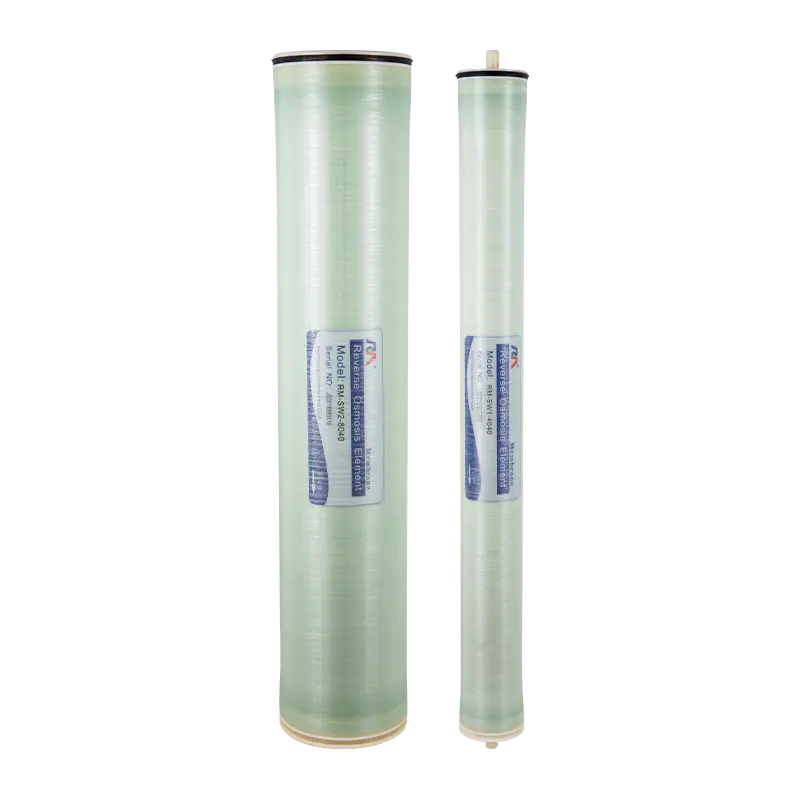
Runmo’s SW Series is described as an aromatic polyamide composite membrane element developed for seawater desalination. According to the manufacturer’s product information, its membrane element structure is optimized to increase water production, and the series is designed to provide good desalination performance and stability. The company also states that its high desalination rate can support obtaining water from seawater through single-stage reverse osmosis.
The SW Series is available in models including RM-SW1-4040 and RM-SW2-8040. The listed membrane areas are 7.4 m² and 35.2 m² respectively, while the manufacturer’s reported average permeate production is 7.2 m³/day and 31 m³/day under its stated testing conditions.
These figures are product testing data rather than universal operating results. Actual performance can vary according to feed-water conditions, system configuration, pressure, temperature, and recovery. That distinction is important when comparing membrane products for a real desalination installation.
Where Desalination Membranes Are Used
Membrane desalination can support several applications beyond municipal drinking-water production. Coastal industrial facilities may need water treated for manufacturing processes, utilities, or boiler-related applications. The SW Series is listed for seawater and high-concentration brackish-water treatment, with applications including seawater desalination, high-concentration brackish-water desalination, power-plant boiler feed water, wastewater reuse, and concentration or recovery of certain valuable substances in food and pharmaceutical processes.
This range of applications shows why seawater RO systems should be designed around the intended water use. A project producing water for general industrial purposes may have different requirements from a system designed to provide water for more demanding downstream processes. The treatment target should be established before equipment, and membrane specifications are finalized.
For organizations developing projects in coastal or water-scarce areas, desalination can also form part of a broader water-management strategy. In some cases, the objective is not simply to produce freshwater, but to reduce dependence on limited conventional sources and make better use of available water resources.
Selecting a Suitable Membrane for the Project
Choosing a seawater membrane starts with understanding the feed water. Salinity is an obvious factor, but it is not the only one. Temperature, turbidity, SDI, hardness, organic content, and operating pH can all affect membrane suitability and system performance.
The published operating limits include a maximum working pressure of 1,000 psi, maximum feed-water temperature of 45°C, maximum feed-water SDI15 of 5, and a continuous operating pH range of 2 to12. These limits should be distinguished from the separate product testing conditions, which use a30,000 ppm Naci solution. The listed testing conditions use 30,000 ppm sodium chloride, 25°C, 5.5 MPa testing pressure, and 8% recovery per element.
Such data provides a useful reference for preliminary product evaluation, but engineering teams still need to compare the manufacturer’s specifications with actual site conditions. A membrane should not be selected solely because it has a high rejection figure. Hydraulic requirements, pretreatment quality, system recovery, cleaning strategy, and replacement considerations all influence the practical result.
Looking Beyond Initial Purchase Cost
For water-treatment contractors and smaller engineering companies, procurement decisions often involve more than technical specifications. Price, quality, delivery time, customization, and technical support can influence whether a membrane is practical for a specific project. A product that matches the equipment specifications and feed-water conditions can simplify membrane integration and future replacement planning.
Runmo presents itself as a direct manufacturer of industrial membrane products and provides product selection and technical support based on feedwater and project requirements. Its SW Series includes membrane elements for seawater and high-concentration brackish-water treatment.
Making Desalination More Practical
Seawater reverse osmosis provides a controlled way to separate dissolved salts from seawater and produce usable treated water. Consistent desalination performance depends on considering membrane selection, pretreatment, operating conditions, and maintenance as parts of one integrated system.
Runmo brings together membrane manufacturing, product selection, and water-treatment support for projects involving different feed-water conditions. Its seawater membrane range is designed for applications such as seawater desalination, high-concentration brackish-water treatment, and wastewater reuse. When planning a new system or upgrading an existing one, starting with actual water conditions and required output quality provides a practical basis for narrowing down the right membrane option.
