
A 400V three-phase distribution system is common in many industrial and commercial environments in Europe and Australia, so the AC connection point becomes an early design constraint for battery storage. The converter cannot be chosen from kilowatt rating alone; the site voltage, neutral arrangement, grounding method, transformer strategy, protection, and expected operating modes all shape the interface.
At 400V, the suitability of a commercial PCS begins with how its AC interface fits the facility’s existing distribution network. The wider power conversion system must also fit the load behavior and microgrid functions required after the electrical connection has been established.

Start With the 400V Point of Interconnection
The relevant voltage is the voltage at the bus where storage will actually connect. A facility may have a 400V low-voltage board, a higher-voltage service with a local transformer, or multiple distribution levels feeding different process areas.
Direct connection is possible only where the commercial PCS AC interface matches the intended bus and phase arrangement; otherwise suitable transformation equipment has to create the required voltage relationship. Current level follows from that decision.
For a given three-phase power rating, a lower AC voltage means higher current, which affects conductors, busbars, breakers, thermal loading, and available fault current. Neutral requirements also matter where single-phase loads are significant. For any specific converter model, the nameplate AC voltage has to match the intended connection point; control capability cannot substitute for verified voltage compatibility.
Load Imbalance and Transients Belong in the Selection Study
Industrial loads vary with motor starting, equipment cycling, and single-phase demand, so average kilowatts alone cannot describe the current an inverter may need to supply. A motor can draw a brief starting surge even when its normal consumption is modest, while uneven phase loading places different demands on each output. The actual load profile therefore determines the overload, voltage-control, and unbalanced-load capabilities required of the commercial PCS.
Protection and switchgear coordination also follow from those conditions. Breaker ratings, cable current, neutral current, fault levels, and expected overload duration have to match both the converter and the facility distribution network.
In retrofit work, existing board capacity and cable routes can determine whether the preferred connection point is practical. If later expansion is expected, parallel capacity and available board space become part of the same study.
Where photovoltaic or generator resources are present, their coupling points and control responsibilities also need to be mapped before the converter arrangement is finalized. A 400V connection that works electrically today can still become restrictive if future power growth was never included in the original design.
Control Functions Determine What Happens During Disturbances
Many C&I batteries are installed for more than peak shifting. Their operating brief can include keeping selected loads energized after a utility interruption, forming a local grid, or sharing power with renewable sources and diesel generation.
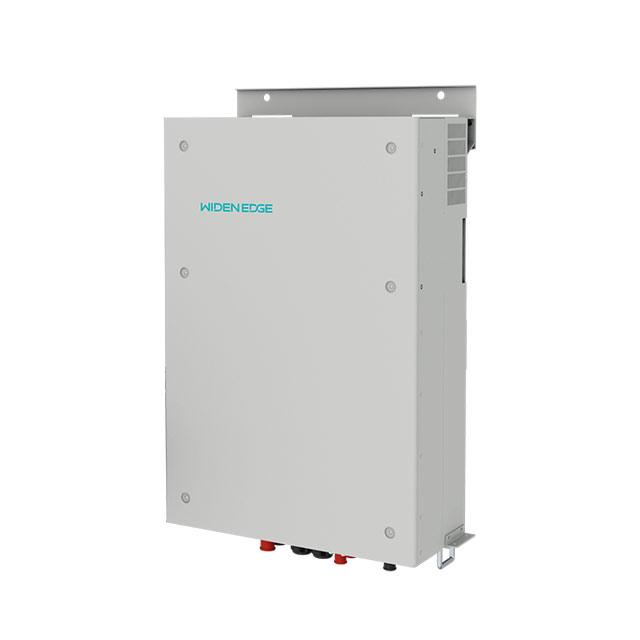
A power conversion system serving those duties needs appropriate control functions once the utility reference becomes limited or disappears. The MGC MK3 combines a virtual synchronous generator (VSG) control strategy with droop control and supports movement between grid-following and grid-forming operation.
Once a PCS is electrically matched to a 400V facility, its control functions determine how storage responds to disturbances. WidenEdge’s MGC MK3 combines grid-forming control with seamless grid-connected/off-grid switching, allowing the local system to adapt when utility power becomes unavailable. Automatic load-response functions address abrupt changes in site demand, while diesel-generator management and parameter self-learning support coordination with backup generation. These functions matter because a suitable voltage interface alone cannot maintain the required operating mode during an interruption.
Transformerless Architecture Changes the Integration Question
A transformer can provide isolation or voltage adaptation, but it also adds footprint, loss, weight, protection requirements, and cost. Where the converter and facility voltage are directly compatible, a transformerless architecture may reduce those additional stages.
The decision still depends on grounding, isolation, utility, and local code requirements rather than on efficiency alone. WidenEdge describes the MGC MK3 as a transformerless grid-forming energy storage inverter with a three-phase four-wire operating concept in related C&I architectures.
For a 400V facility with uneven phase loading, two capabilities become particularly relevant: independent neutral-line current regulation while grid-connected and support for 100% unbalanced loads after islanding. Those capabilities concern load behavior and neutral management; they do not remove the need to verify the exact AC voltage rating for the selected model.
A 400V Project Is a System-Matching Exercise
For a 400V project, the decisive electrical checks are linked rather than a fixed sequence. Phase and neutral behavior together with the actual load profile shape current paths and protection needs; the connection point and transformer strategy establish the AC interface; operating modes, battery integration, communications, generator coordination, and expansion determine how the PCS functions after connection.
A feature-rich converter still fails the project if those electrical and operating conditions do not fit the same site. At the platform level, storage conversion is only one layer: WidenEdge links MGC inverters with PV/DC and EV/DC conversion stages plus Hub local control so batteries, renewables, diesel generation, and site loads can operate across grid-connected, weak-grid, off-grid, and hybrid projects.
That architecture keeps the PCS connected to the same local coordination layer as other resources. In a European or Australian 400V C&I application, those system functions can be evaluated only after exact model voltage compatibility is confirmed.
A suitable power conversion system is ultimately one whose electrical interface and operating behavior fit the same facility, without forcing avoidable transformation or sacrificing the functions the project actually needs.
SEO Title: How to Select a Commercial PCS for 400V C&I Energy Storage Projects | WidenEdge
Meta Description: Read our latest insights on How to Select a Commercial PCS for 400V C&I Energy Storage Projects. Explore voltage, load behavior, control, and integration.
