
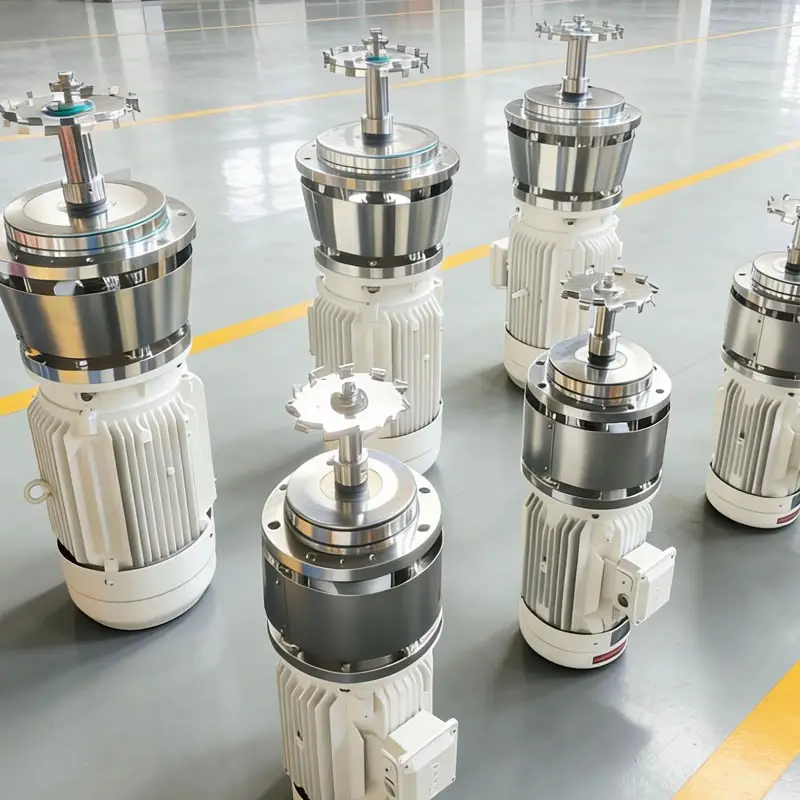
Selecting industrial mixing equipment requires more than comparing motor power, rotational speed, and processing capacity. Manufacturers must determine whether a machine can handle the actual formulation, achieve the required product quality, and operate reliably under intended process conditions. Sample testing services help purchasing teams and process engineers evaluate these factors before committing to production equipment, reducing technical uncertainty during equipment selection and scale-up.
Why Sample Testing Matters in Industrial Mixing

Industrial formulations can behave very differently depending on viscosity, solid content, temperature, and the interaction between ingredients. A process that works with water may produce inconsistent results with a concentrated suspension, viscous cream, or difficult-to-disperse powder mixture. Laboratory testing using a high shear mixer provides an opportunity to examine these variables under controlled conditions.
For buyers evaluating industrial mixing machine manufacturers, sample testing also creates a practical basis for comparing equipment suitability. Instead of relying solely on catalogue specifications, buyers can assess dispersion quality, emulsification performance, processing time, and material stability using their own formulations.
Key Services Available Through Sample Testing
1.Formulation Feasibility and Process Evaluation
The first stage typically examines the material and its processing objectives. Buyers may provide ingredient information, target viscosity, desired particle size, operating temperature, and other relevant parameters. Engineers can then identify an appropriate test method and determine whether the proposed equipment configuration is suitable for further evaluation.
For a high shear mixer, testing can investigate how effectively the equipment disperses solids, breaks down droplets, or forms a uniform emulsion. Results depend on the formulation and operating conditions, so preliminary trials should establish realistic expectations rather than promise identical outcomes for every material.
2.Dispersion, Emulsification, and Homogenization Tests
Different applications require different performance indicators. Powder-liquid dispersion may be assessed through visible agglomeration, particle-size measurements, or uniformity checks. Emulsification trials can examine droplet distribution and resistance to separation, while homogenization tests may focus on consistency throughout the batch.
As one of the industrial mixing machine manufacturers, FLUKO develops equipment for dispersion, emulsification, homogenization, and mixing across laboratory, pilot, and industrial applications. Its rotor-stator technology for intensive processing, making application-specific trials relevant when evaluating formulations that require fine dispersion or stable emulsions.
3.Parameter Optimization and Repeatability
Testing should examine more than one operating condition whenever practical. Speed, processing duration, feed rate, temperature, and ingredient addition sequence may affect the final result. Changing one variable at a time helps engineers understand which conditions influence performance and identify a workable operating window.
Repeatability is equally important. A successful single trial does not necessarily demonstrate that a process will remain consistent across multiple batches. Recording test conditions and repeating representative runs can reveal variations, support process documentation, and provide a stronger foundation for subsequent equipment specification.
How Testing Supports Equipment Selection and Scale-Up
- Matching Equipment to Real Production Requirements
Laboratory equipment is useful for screening formulations, but production equipment must also accommodate batch volume, material viscosity, heat generation, cleaning requirements, and plant layout. Sample testing can help identify whether batch processing or inline processing is more appropriate for the intended operation.
When assessing industrial mixing machine manufacturers, procurement teams should ask how laboratory findings will inform equipment selection. A useful evaluation connects test results with the proposed machine configuration, operating range, vessel arrangement, and production objectives. This makes the purchasing decision more technically defensible.
- Evaluating Scale-Up Risks
Moving from a small sample to a production batch can change circulation patterns, heat transfer, residence time, and the distribution of energy throughout the material. Consequently, laboratory results should guide scale-up rather than serve as an automatic guarantee of industrial performance.
Pilot-scale trials can bridge this gap by testing a larger quantity under conditions closer to production. Depending on the process, engineers may compare product quality, processing time, temperature changes, and operating stability. The findings can help identify additional validation needs before full-scale commissioning.
What Buyers Should Confirm Before Booking a Test
A productive testing service begins with clear objectives and representative materials. Buyers should confirm the sample quantity required, testing equipment available, analytical methods offered, expected deliverables, and whether pilot-scale trials can be arranged if needed.
It is also important to establish how results will be documented. A useful report should record the material characteristics supplied, equipment configuration, operating parameters, observations, and measured results where applicable. Any limitations should be stated clearly, particularly when the sample differs from the intended production formulation.
Confidentiality deserves attention as well. Industrial formulations may contain commercially sensitive information, so buyers should clarify sample handling, data access, and any confidentiality arrangements before sharing proprietary materials.
FLUKO’s Approach to Application Testing
FLUKO is a high shear mixer manufacturer with equipment spanning laboratory, pilot, and industrial processing. The customers can visit its laboratory to conduct tests using regular laboratory and pilot equipment. For special requirements, industrial production prototypes may also be available for testing, subject to consultation with a sales engineer.
The company also describes research and development in process intensification, supported by patents, international research publications, and a quality system. These capabilities are relevant to buyers seeking technical discussion alongside equipment evaluation. Specific test availability, deliverables, and suitable configurations should be confirmed directly with FLUKO.
Turning Test Results into Better Purchasing Decisions
Sample testing is most valuable when it connects material behavior with measurable acceptance criteria and practical production requirements. By examining formulation feasibility, dispersion quality, process repeatability, and scale-up considerations, buyers can reduce uncertainty before selecting industrial equipment.
Rather than choosing solely by headline specifications, businesses should evaluate the testing support, technical communication, and documented evidence offered by potential suppliers. A structured trial provides a more informed basis for equipment selection, process development, and long-term manufacturing planning.
