
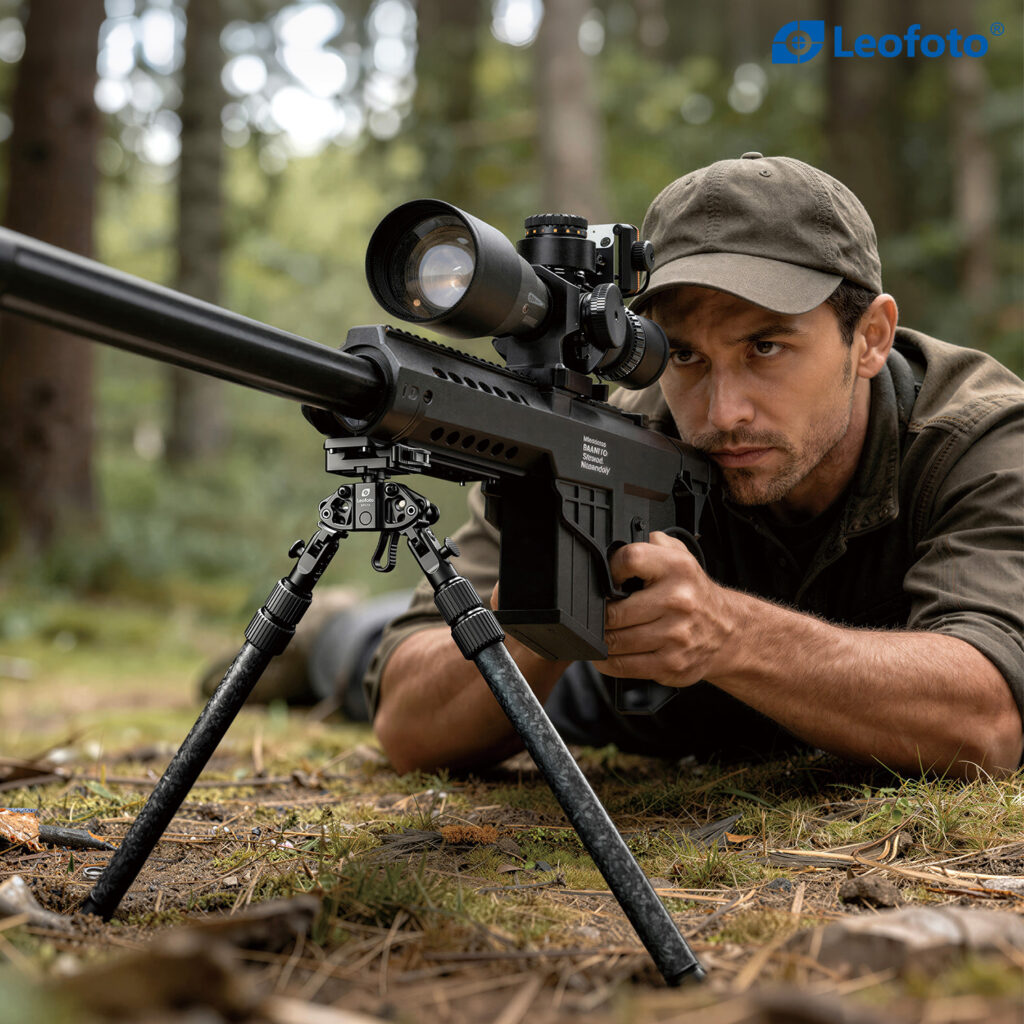
Determining what defines a top-tier field support requires evaluating how well equipment adapts to irregular backcountry terrain. Shooters frequently encounter steep grades, tall brush, and shifting winds that test mechanical hardware. Equipment must deliver dependable stability without burdening long mountain treks.
Selecting a dedicated rifle bipod for hunting involves analyzing specific mechanical capabilities rather than relying on brand reputation alone. Field accuracy requires an adaptable platform that transitions between prone and elevated positions. These mechanical elements separate reliable gear from fragile alternatives.

Elevation Versatility Across Ground and Mid-Level Shooting Heights
Field conditions rarely present uniform shooting positions across wilderness environments. Dense grass, low shrubs, or boulder fields frequently obstruct clean sightlines, making rigid prone bipods ineffective. Support platforms must provide vertical flexibility to maintain clear lines of sight over ground obstacles.
Three-section telescopic carbon-fiber legs deliver elevation versatility across shifting terrain. Stepped leg tube diameters measuring 22 mm, 19 mm, and 16 mm provide balanced structural stiffness during rapid extension. Ergonomic twist locks permit fast deployment, letting hunters adjust leg stages swiftly as game moves.
Variable height spanning from 210 mm to 775 mm accommodates diverse firing stances during active stalks. Low ground-hugging adjustments down to 210 mm minimize shooter silhouette during meadow glassing or prone shooting. Extending legs toward 775 mm enables stable seated or kneeling shots over tall vegetation.
Steeper hillsides and rocky outcrops demand quick adjustments to keep firearms properly elevated. Independent leg length modifications compensate for sharp elevation drops beneath the rifle forend. Adapting vertical stance quickly prevents shooters from adopting awkward bodily positions on uneven terrain.
Integrated Ball-Joint Dynamics and Multi-Axis Angle Alignment
Maintaining target acquisition across uneven wilderness terrain requires dynamic head movement. Deploying a specialized hunting bipod with an integrated ball joint enables fluid orientation adjustments across irregular surfaces while keeping leg pads planted securely. Mechanical flexibility permits rapid leveling without disturbing established ground footings.
Hardware designs produced by Leofoto utilize an integrated ball joint providing 360-degree horizontal panning, positive and negative 15 degrees of side cant, and 5 degrees of tilt. Articulation isolates the rifle from uneven ground, facilitating smooth tracking without shifting the base.
Lateral cant adjustments correct reticle tilt on angled sidehills, preventing horizontal shot drift at long distances. Precise pitch movement assists target acquisition across steep ravines, while rotational panning tracks moving game across basins. Controlled friction damping maintains smooth movement under heavy field loads.
Mounting Interfaces, Lever Security, and Clamping Regulation
Solid firearm attachment forms the foundation of precision shooting in backcountry basins. A rifle bipod for hunting must attach securely to the forend without shifting under recoil. Quick-release clamps facilitate rapid field installation, allowing hunters to mount or detach supports during fast-moving encounters.
Dual-standard compatibility allows the clamp to accept Arca-Swiss dovetails and Picatinny rail interfaces directly. Integrated compatibility removes the need for bulky aftermarket plates that increase stack height and weight. Low-profile clamping hubs keep the barrel axis close to the pivot center, minimizing muzzle climb.
Tension regulation on the clamp mechanism dictates how firmly a hunting bipod grips the rifle rail. Lateral fine-adjustment dials permit precise calibration of clamping force to match dimensional variations across different rails. Dialing in exact tension prevents unwanted movement while maintaining smooth lever closure.
Concealed secondary safety latches engineered by Leofoto protect against accidental lever release during rugged transit. The primary locking lever opens only after depressing an internal safety catch, stopping accidental snagging on brush, pack straps, or outerwear. Dual-safety engineering preserves mounting integrity across demanding cross-country treks.
Independent Leg Articulation and Surface Footing Dynamics
Angular leg adaptability separates specialized field supports from restrictive target accessories. Mountain terrain frequently presents vertical drop-offs, fallen logs, and jagged ledges that prevent standard leg deployment. Independent angle adjustments allow customized stances tailored directly to immediate topography without sacrificing structural rigidity.
Four selectable leg angle positions at 35, 65, 95, and 125 degrees offer comprehensive operational versatility. One-touch adjustment tabs permit rapid angle changes with a single motion, enabling fast transitions between wide-splay prone stances and seated configurations. Broad leg splay stabilizes setups on downhill slopes.
Ground conditions vary between slick granite, wet mud, loose shale, and deep snowpack. Equipping a rifle bipod for hunting with interchangeable feet maintains positive surface traction across varied substrates. Stable ground contact prevents support legs from slipping forward when loading into the rifle stock.
Interchangeable footing options include standard textured rubber pads and claw-style steel spike feet. Rubber pads deliver firm grip on hard rock slabs and smooth surfaces without skidding. Claw-style steel spikes bite deeply into turf, mud, and frozen gravel to establish an immovable base.
Transport Dimensions, Bi-Directional Folding, and Pack Burden
Total carry weight directly influences physical stamina during strenuous wilderness climbs. Multi-functional shooting supports from Leofoto integrate carbon-fiber leg tubes with CNC-machined aluminum components, balancing structural strength and transport ease. This construction keeps platform weight to 485 g, reducing pack burden on extended mountain hunts.
Bi-directional folding geometry allows legs to collapse forward or rearward into a compact 350 mm transport profile. Stowing a hunting bipod within side pack pockets or streamlined scabbards prevents external gear snagging in dense timber. One-touch folding mechanisms allow swift deployment when game suddenly appears.
Defining the Optimal Wilderness Support Platform
Balancing minimal weight against mechanical stability determines overall equipment effectiveness in remote terrain. Backcountry hunters gain little benefit from lightweight supports that flex under recoil, or heavy bench rests that burden packs. Dependable performance stems from combining broad elevation ranges, solid rail retention, and multi-axis ball-joint articulation.
Rigorous field evaluation confirms that versatile mechanical adaptability defines top-tier equipment. Multi-position leg spreads, secure dual-safety lever clamps, and interchangeable footing establish a dependable shooting platform across wilderness environments. Selecting hardware built around these attributes equips hunters with reliable stability across demanding backcountry hunting encounters.
