
Production schedules rarely consist of identical sheets moving through the same cutting cycle all day. One shift may involve thin stainless steel panels, while the next requires thicker carbon steel components with different edge-quality expectations. Selecting equipment around the thickest material alone can distort investment decisions and leave useful capacity underused.
A practical assessment of a sheet metal fiber laser cutting machine starts with the actual mix of materials, thicknesses, part geometries, and order volumes. Hymson Laser Machinery operates in this industrial equipment sector, where matching machine capabilities to real production demands matters more than relying on headline specifications.

Build a Realistic Profile of Daily Cutting Work
Material thickness is only one variable in a mixed-job environment. Sheet dimensions, alloy composition, surface condition, required tolerances, and the number of contours on each part all affect cutting performance. Reflective metals and thicker sections may create different process demands from thin mild-steel sheets, even when the nominal cutting speed appears comparable. Reviewing representative production drawings helps engineers identify which jobs place the greatest demands on the equipment and which account for most of the daily workload.
Production frequency provides another useful measure. A thick plate processed once a week should not automatically determine the machine configuration if most orders involve thinner sheets. Buyers can group recent jobs by material, thickness, cutting length, and batch size, then calculate the share of total operating hours associated with each group. This profile reveals whether the workshop needs exceptional capacity for occasional jobs or balanced performance across a broad range of routine orders.
The distinction between capability and utilization is especially important. A high-power laser cutting machine may process certain thick materials effectively, but its maximum rated power does not indicate how much productive time it will save across the entire order book. If most work involves thin sheets, loading delays, part sorting, programming, and setup changes may account for more lost time than the cutting process itself. Capacity planning should consider these surrounding tasks alongside the laser source.
Match Laser Power to the Actual Workload
Higher laser power can expand the range of materials and thicknesses a workshop can process, but the benefits depend on the jobs involved. For suitable materials and cutting conditions, additional power can increase cutting speed or support thicker sections. However, the relationship is not uniform across every metal, gas setting, nozzle, or part geometry. Process trials using representative production materials offer more useful evidence than a single maximum-thickness figure in a brochure.
Thin-sheet production calls for a different evaluation. At higher speeds, sheet stability, acceleration, contour complexity, and the machine’s motion system can influence cycle time. Parts with many small holes or intricate profiles may not achieve the same productivity gains as long, uninterrupted cuts. Buyers should compare finished parts per hour, acceptable edge quality, and scrap rates rather than assuming that greater source power translates directly into proportional output increases.
Evaluate the Whole Machine, Not the Laser Source Alone
Power is only one component of cutting-system performance. The bed structure, motion control, acceleration, positioning accuracy, cutting head, cooling system, and software all influence how consistently the machine handles different sheet jobs. Weaknesses elsewhere in the system can limit the practical benefit of a more powerful laser source. Technical evaluations should therefore examine the machine as an integrated production asset rather than ranking options by kilowatts alone.
Automation also affects utilization, particularly in facilities processing frequent small batches. Automatic loading and unloading may reduce manual handling, while suitable nesting software can improve sheet utilization and shorten programming time. Yet automation brings its own requirements, including floor space, material staging, maintenance, and staff training. Its value depends on whether the production schedule provides enough repeatable work to keep the added equipment productive.
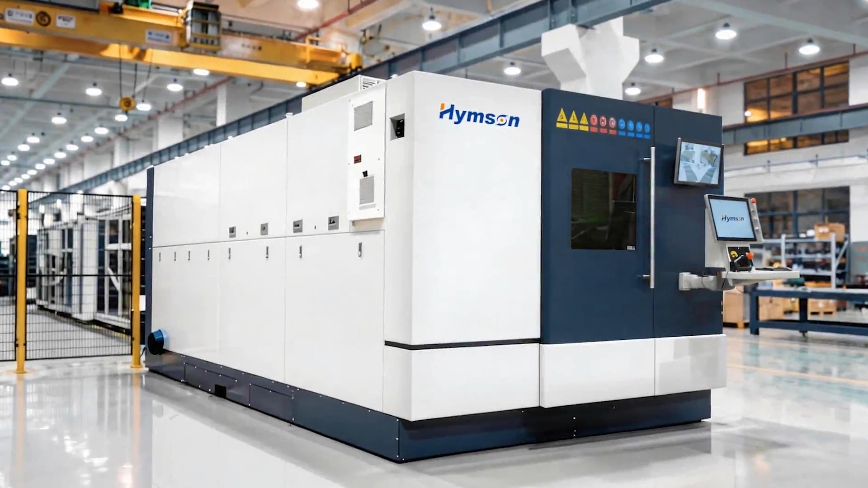
The Hylaser PRO is designed for high-intensity, continuous production environments, with flexible automation scalability intended to support changing production demands. For buyers comparing configurations, the relevant question is how such capabilities fit the workshop’s expected workload, staffing, and shift pattern. A high-power laser cutting machine becomes a stronger investment candidate when its cutting capacity and surrounding automation address identifiable bottlenecks rather than simply exceeding current requirements.
Compare Production Scenarios Before Committing
A useful comparison begins with several representative job scenarios: high-volume thin sheets, recurring medium-thickness parts, and the thickest materials the workshop expects to process regularly. Each scenario should be assessed for cycle time, loading and unloading time, edge quality, material yield, and operator involvement. Consistent test conditions make differences between machine configurations easier to interpret and help prevent isolated demonstrations from shaping the entire purchasing decision.
Capacity planning should also include foreseeable changes in the order mix. New customers may introduce unfamiliar materials, while existing contracts may shift toward smaller batches or tighter tolerances. Rather than paying for every possible future requirement, buyers can identify the most likely changes and determine which configuration provides useful flexibility. Supplier discussions should clarify upgrade options, compatibility limits, and the costs associated with expanding automation or changing the production setup.
Conclusion
Selecting equipment for mixed-thickness work requires a clear picture of what the workshop cuts most often, where production time is lost, and which future jobs are reasonably likely. A balanced review of material mix, process results, motion performance, automation, and operating expenses provides a stronger basis for investment than maximum power alone.
Hymson Laser Machinery, like any industrial equipment supplier, should be assessed against documented capabilities and the workshop’s actual production scenarios. Ultimately, the most suitable sheet metal fiber laser cutting machine is the one whose usable capacity aligns with real demand, while the value of a high-power laser cutting machine depends on whether its additional capability translates into sustained, measurable productivity.
