
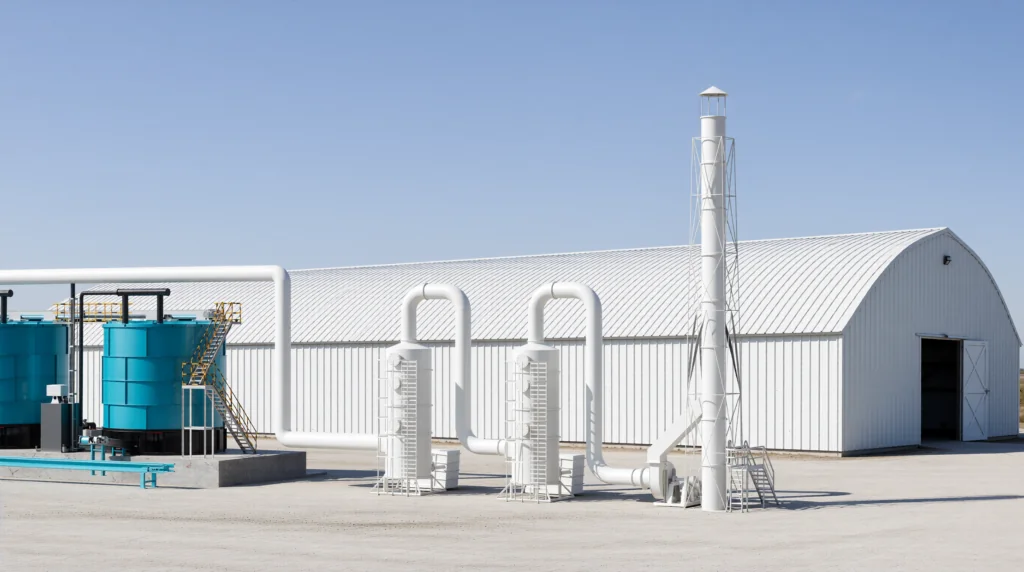
Across livestock operations—whether rabbits, poultry, or cattle—manure management remains a fundamental concern. Storing waste in open piles can lead to odor complaints, nutrient runoff, and regulatory scrutiny. An in vessel composting machine offers a different path: it transforms raw manure into stable compost inside a sealed, controlled environment. By doing so, it gives farmers a reliable way to handle waste without disrupting daily routines, while turning a disposal problem into a usable product. For those raising animals, understanding how this equipment works is the first step toward more sustainable operations.
Covering Multiple Livestock Types with One System
One of the strengths of in vessel composting lies in its adaptability across different animal operations. The treatment scope of in vessel composting equipment mainly covers livestock farms, including those raising rabbits, chickens and ducks, cattle and sheep, and pigs. Each of these sectors produces manure with unique characteristics—poultry litter often contains bedding material, while dairy manure tends to have higher moisture. A well-designed in vessel composting machine can handle these variations because the process is controlled mechanically rather than relying on ambient conditions. This means a single system can serve a mixed farm or be scaled to suit a specialized operation, all while maintaining consistent composting results.
Matching Equipment to Specific Operational Needs

No two livestock farms manage their time, labor, or space in exactly the same way. Recognizing this, Cason ensures that a customizable in-vessel composter perfectly fits individual operational needs. They work with producers to assess factors such as daily waste volume, available floor space, and existing handling equipment. From there, the system’s size, retention time, and aeration schedule can be adjusted accordingly. This level of customization means the equipment does not force a farm to change its workflows; instead, it integrates smoothly, reducing the learning curve for staff and allowing operations to continue without interruption.
Building Efficiency Through Personalized Design
When an in vessel composting system is designed with the producer’s specific context in mind, the benefits extend beyond waste reduction. Cason’s approach focuses on creating a more efficient and personalized composting solution, which translates to lower energy use per ton processed, less manual handling, and a more predictable end product. For livestock farmers, that efficiency matters: it frees up time to focus on animal care and herd management, while the finished compost can be used for bedding, pasture improvement, or even as a revenue stream. The personalized nature of the equipment also means that if a farm expands or changes its livestock mix, the system can often be adapted rather than replaced.
Adopting an in vessel composting machine is not merely about installing new equipment; it is about rethinking how livestock waste fits into the overall farm system. With the ability to serve everything from rabbitries to pig operations, and with customization options that match real-world needs, this technology gives producers a practical, long-term tool. Farms that make the switch often find that what was once a daily burden becomes a straightforward, even valuable, part of their operation.
