
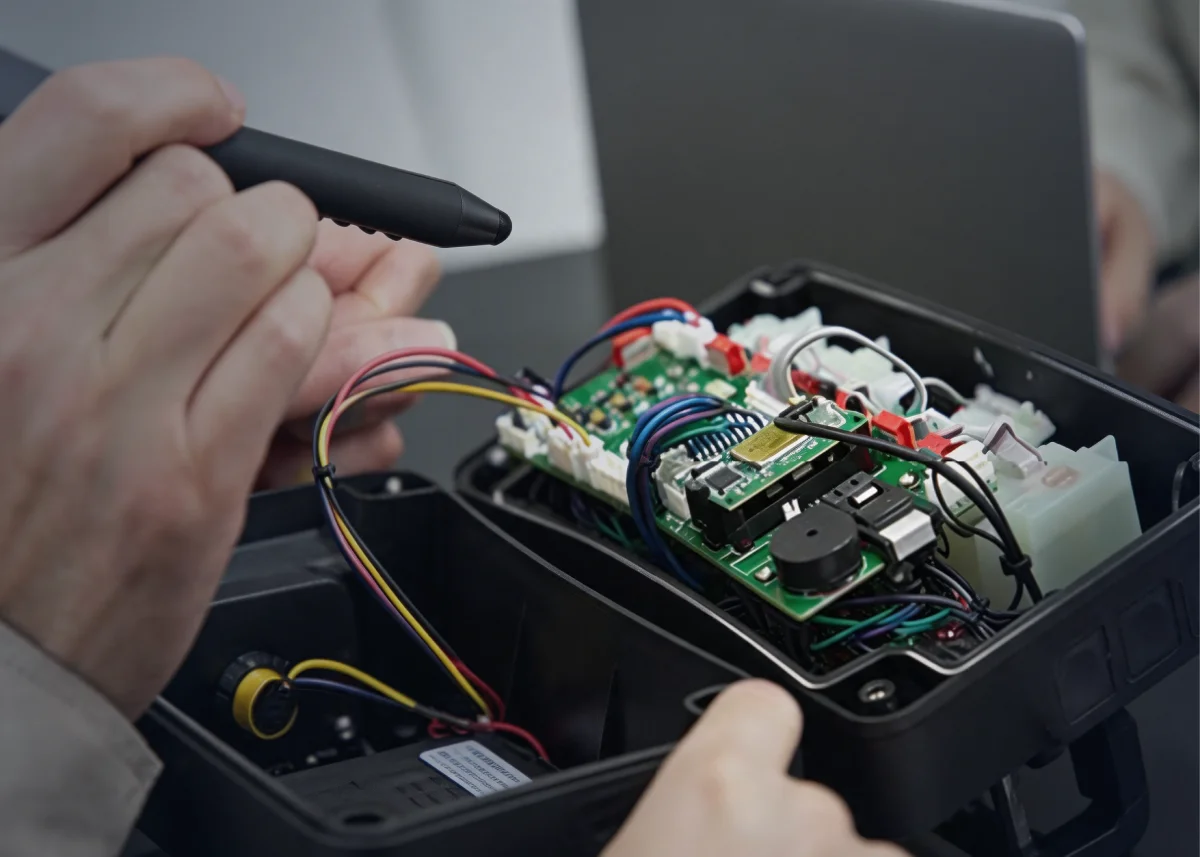
Manufacturers of cranes, mining vehicles, and hydraulic machinery often require remote control systems tailored to their equipment, as generic transmitters may not provide the compatibility or functionality needed for custom-built machinery. This integration process involves more than selecting a suitable transmitter; it extends from defining application requirements to manufacturing, testing, and ongoing support.
Step One: Requirement Confirmation
The process begins with three inputs: the equipment type (crane, excavator, mining vehicle and so on), the working environment, and the functions the operator needs. Techwell’s engineers review these before recommending a configuration. A crane in a warehouse and a vehicle in an open-pit mine place very different demands on a transmitter, so skipping this step usually leads to a mismatched product.

The environment details should be specific. Temperature range, electromagnetic conditions, variable-frequency drives (VFDs) nearby and the number of machines operating together all affect the configuration. Techwell lists an operating range of -25°C to 70°C and a line-of-sight range of at least 150 m in open field for its standard crane systems.
Step Two: Proposal and Panel Layout
The next stage turns requirements into a written proposal. Techwell says the proposal covers frequency configuration, joystick layout, receiver compatibility and pricing. This is where industrial wireless control systems are matched to a specific machine, rather than the OEM adapting its design to a standard catalog item.
For OEMs, the panel layout matters most here. Button positions, joystick type and travel, labeling and logo placement all need to be fixed on a panel drawing before production. Techwell’s OEM service covers custom housing, button and panel colors matched to RAL or PANTONE codes, new form factors, and accessories such as chargers, cases and cables. OEM customers can also request customized interfaces and control logic through the CODESYS platform, which is compatible with mainstream PLCs and hydraulic controllers.
Step Three: Technical Agreement
Once the proposal and panel drawing are agreed, the specification should be fixed in a written technical agreement before production starts. It should record the frequency and channel plan, the function of each button and joystick axis, the receiver output type, the optional functions, the applicable standards, and the certificate scope for each model. Any later change then goes through a documented revision, which keeps the OEM’s engineering and procurement teams working from the same document.
Techwell’s functional safety rating is Performance Level d (PL d) under EN ISO 13849-1:2015, and its radio compliance is stated as ETSI EN 300 220. Each rating should be written into the agreement against the specific model being ordered.
Step Four: Manufacturing and 72-Hour Testing
Techwell states that every remote control is assembled in its ISO-certified facility and undergoes 72-hour stress testing before shipping. The tests cover signal interference, temperature and impact. For an OEM that will sell and warrant the finished machine, this lowers the risk of a control component causing field failures.
Step Five: Delivery and After-Sales Support
After testing, units ship globally with tracking. Techwell provides user manuals, programming software and technical support for the field phase. Its Solution page says quote requests are answered within 24 hours, and the company cites 24/7 technical assistance. For OEMs selling across borders, easy field servicing and reprogramming matter as much as the original configuration.
Project Examples
Three models on Techwell’s Solution page show how the process produces different configurations.
The T-B247 is used for electrolytic aluminum cranes, where operating conditions include high heat and strong electromagnetic fields. It supports one-to-many and many-to-one control for warehouse crane clusters. This model should not be read as an explosion-proof product. Techwell’s site does not state an Ex certificate for it, and OEMs should not assume one.
The T-P500 is configured for 5-tonne lorry cranes. Its anti-interference performance is aimed at VFD environments, and it allows single-person operation with full visibility. Techwell reports 50% labor savings and an 80% efficiency gain for this application, and these are the company’s own figures.
The FYF20C is intended for coal mining. It lets operators work away from the rig and offers strong anti-interference performance in VFD environments. Techwell describes its mining range as Ex-certified for hazardous zones, but certificate scope differs by model. An OEM using the FYF20C should ask for the certificate covering that exact model and the intended hazardous area.
IP Rating Is Not Explosion Protection
Ingress protection (IP) and explosion protection are separate things. An IP rating, such as the IP66 that Techwell lists under IEC 60529, describes resistance to dust and water. It says nothing about use in atmospheres with explosive gas or dust. That requires an Ex certification issued for a specific model and a specific hazardous-area category. PL d, in turn, is a functional safety rating and is separate from both. Protection ratings on Techwell’s site appear as IP65 or IP66 depending on the page, so the rating on the model’s datasheet is the one to rely on.
What OEMs Should Confirm Before Committing
Before choosing a supplier, OEMs should ask four things. Can the frequency and receiver configuration be tailored to the machine’s actual environment? Is the technical specification, including the panel drawing, documented before production? Do certificates cover the exact model ordered, with Ex, IP and PL d kept separate? And are manuals, programming tools and technical support included? An industrial wireless remote control system that meets these points tends to fit an OEM’s production and service workflow better than one chosen on price alone.
Conclusion
Integration works best when the sequence is followed in order: requirement confirmation, proposal and panel drawing, written technical agreement, tested manufacturing, then delivery and support. Techwell Remote Control structures its OEM engagement this way, backed by project examples in aluminum crane operation, lorry cranes and coal mining. OEMs who ask for model-specific certificates and documented specifications at the start avoid most integration problems later.
