
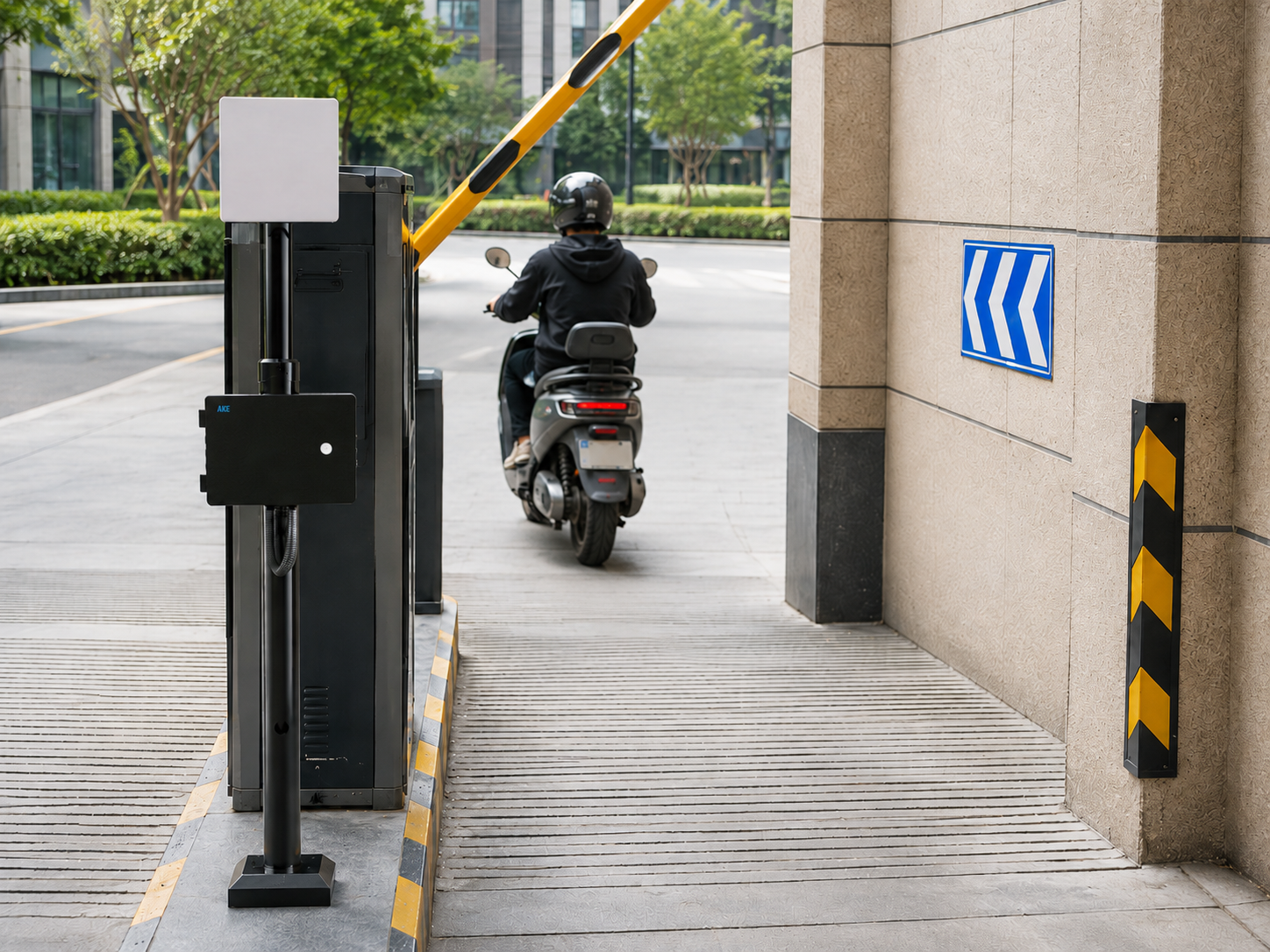
An office car park and a residential e-bike garage may belong to the same property, yet their entrances identify different things. Cars normally present a visible license plate; a tagged two-wheeler presents an issued electronic credential.
Those inputs affect where equipment belongs, which records it needs, and how access decisions reach a barrier. Comparing ANPR with RFID therefore begins with the vehicles and identity carriers present at each controlled entrance, rather than a general claim that one technology is preferable.

What Each Method Reads
Automatic number plate recognition converts characters in a camera image into a plate identifier. In ANPR parking, that identifier provides a reference for looking up a vehicle record. The camera needs a usable view of the plate, but a readable number alone does not establish whether the vehicle has permission to enter.
RFID reads an electronic credential through radio communication. A tag must first be issued and associated with the intended access arrangement. Unlike a plate image, its identifier does not depend on seeing printed characters. The relevant physical condition is whether the credential can be read within the installation’s configured reading area.
Both methods supply identity information to a separate decision. The rules within LPR parking management systems may consider permitted access or payment status before sending a gate command. An RFID arrangement likewise needs an authorization relationship behind the tag. Recognition answers which identifier was presented; authorization determines what that identifier permits.
Match Inputs to Entrance Conditions
A vehicle survey turns those mechanisms into practical selection criteria. For cars, the survey establishes which plates are present, their visibility along the approach, and the available camera view. Dirt, obstructions, turning movements, and lighting changes are reasons to inspect actual images rather than assume that every arrival will provide the same visual input.
For two-wheelers using electronic tags, the corresponding questions concern tag issuance, vehicle association, and the reading zone. A reader positioned near adjacent movement paths requires checks that the intended credential is being captured. Its stated reading distance describes one device characteristic; it does not, by itself, define the correct boundaries of a particular entrance.
A site considering ANPR parking can compare its vehicle mix and plate visibility with the equipment’s stated support. For LPR parking management systems, the survey also identifies vehicles that need a different credential arrangement or staff assistance. This produces a classification of usable inputs, with exceptions attached to specific vehicles and entrance conditions.
Connect Identification to Control
A recognized credential still needs a defined route to authorization, payment information, driver messages, and barrier control. These responsibilities may sit in different devices or software. The interface specification needs to establish which component receives the identifier, which component makes the access decision, and which output communicates the resulting instruction at the entrance.
AKE Parking specifies its Prime LPR Controller for all-weather plate recognition at speeds up to 20 km/h, with a recognition rate of at least 99.9%. It supports regional plates, including those from Hong Kong, Macao, and Taiwan. Its 21.5-inch LCD displays access messages and QR codes. The terminal brings camera recognition, control, supplementary lighting, and parking payment software into an entrance arrangement intended for commercial centers, offices, residential communities, and technology parks.
Outdoor suitability also needs model-specific checking. Prime lists IP54 protection, a working range from -30°C to +70°C, ventilation, heating, and measures against fog and condensation. The enclosure’s protection rating and temperature range describe exposure limits, whereas plate visibility depends on camera positioning and the actual weather and lighting along the vehicle approach during operation at each installation.
Prime lists TCP/IP, RS485, and 4G communication, with offline operation and billing also supported. Those features provide specific integration questions for LPR parking management systems; connection names do not prove that every external platform will interpret the same data. The control design for ANPR parking still needs an agreed transfer of identifiers, decisions, and gate instructions.
Divide Mixed Sites by Vehicle Use
A mixed property can assign different identification arrangements to its car and two-wheeler areas. The relevant RFID example is AKE Parking’s RFID Access Controller for residential e-bike garages, industrial parking sheds, campus motorcycle areas, and similar two-wheeler entrances. The integrated RFID reader has a specified reading distance of 3–5 m. The controller can work with electronic tags, desktop card issuers, and network controllers.
That controller combines network control, fee deduction, and barrier linkage; tag printing, housing colors, and multi-channel control can be customized. These features are intended for two-wheeler access control. They are not a measured comparison against Prime at a car entrance. Likewise, the plate conditions relevant to ANPR parking cannot be replaced by an RFID range figure.
Where the property retains its own SaaS management platform, AKE Parking offers customized hardware integration. The project still needs to identify the exchanged data and control responsibilities. Keeping two-wheeler credentials distinct from records in LPR parking management systems makes each entrance’s identification source and permitted actions explicit, even when operators oversee the property centrally.
Controlled sites can organize their choice around a simple mapping: vehicle type, available identity carrier, reading conditions, and the rule governing access. A plate-based car entrance and a tagged two-wheeler entrance may coexist without sharing identical capture equipment or credentials. The suitable arrangement is the one that gives each vehicle group an appropriate identifier and connects that identifier to clearly defined permission and barrier control.
