
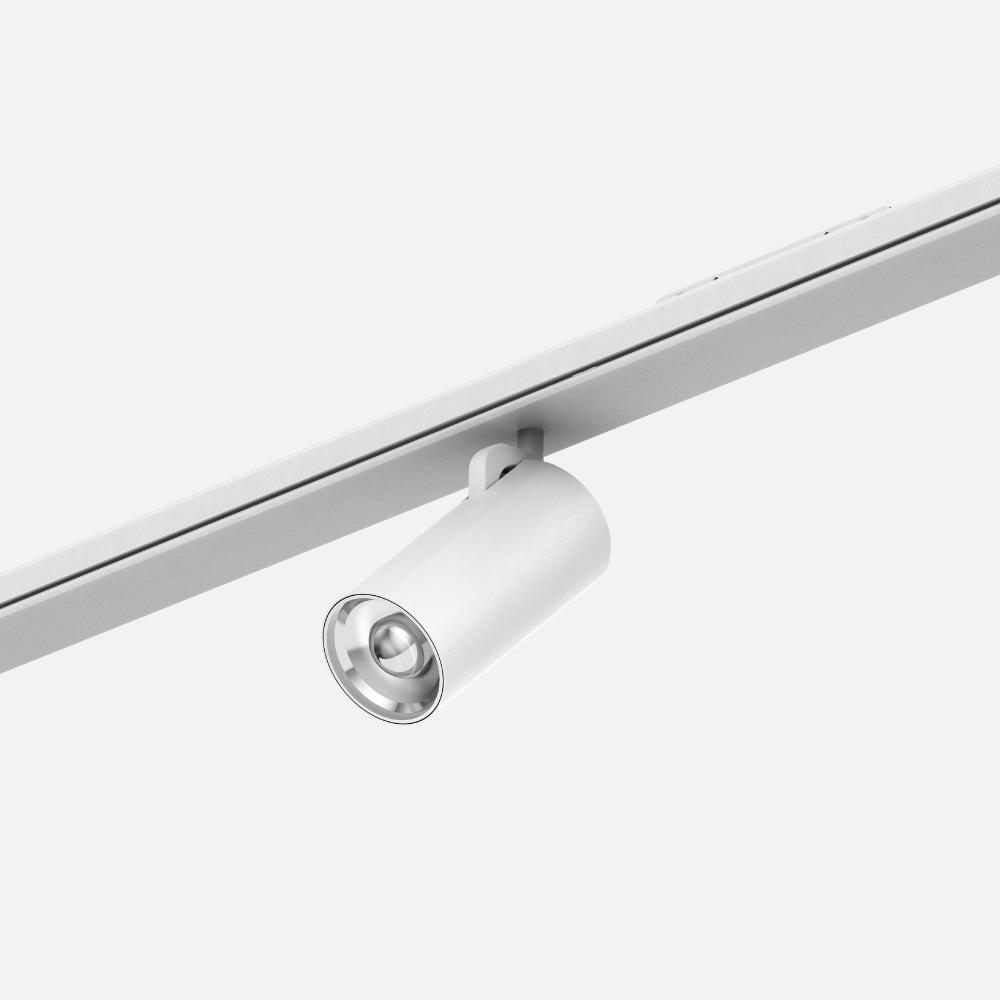
Commercial retail environments require a subtle balance between aesthetic appeal and engineering performance. Light is not merely an operational necessity; it serves as a powerful visual merchandising tool that guides customer movement, highlights premium merchandise, and shapes brand perception. Facility managers, retail architects, and store planners face significant decisions when upgrading or designing ceiling-mounted illumination schemes.
While high-ceiling logistics hubs and production floors prioritize broad lumen output through heavy-duty industrial lighting configurations, retail sales floors demand a far more nuanced approach to contrast, beam angles, and color rendering. Choosing the appropriate track-based setup requires evaluating photometric metrics, spatial flexibility, thermal performance, and manufacturing compliance.

Modern retail layouts continuously evolve to accommodate seasonal collections, promotional displays, and changing foot-traffic patterns. Static ceiling fixtures lack the agility needed to support these dynamic merchandising strategies.
Track-mounted systems solve this challenge by providing a continuous power channel across the ceiling grid, enabling store operators to position, angle, and swap light heads as product displays transition. Making an informed capital investment in these systems requires a clear understanding of the key technical criteria that govern performance in commercial spaces.
Strategic Visual Merchandising and Photometric Performance Parameters
The primary objective of retail track lighting is to present products in their truest, most appealing form. Achieving this requires close attention to the Color Rendering Index (CRI) and Color Fidelity Index (Rf).
Standard commercial fixtures often exhibit CRI values around 80, which can leave vibrant textiles, cosmetics, and organic materials looking washed out or discolored. In many premium retail segments—such as luxury fashion boutiques, fine jewelry counters, and cosmetic displays—luminaires with CRI > 90 and high R9 are frequently specified to ensure accurate rendering of deep red and saturated tones.
Beyond color accuracy, optical beam spread determines how effectively a luminaire creates depth and hierarchy within a store. Spotlights with narrow beams (15° to 24°) generate dramatic contrast, drawing immediate attention to featured focal points or mannequin displays.
Conversely, wide flood distribution (36° to 60°) provides uniform ambient fill across broad shelving units and apparel racks. Advanced track luminaires incorporate large-emitting-surface optics to maintain high luminous flux while minimizing glare, preventing visual fatigue for shoppers and store personnel alike.
Modular Architecture and Flexible Track Integration
Physical infrastructure plays a decisive role in the long-term utility of a lighting installation. Selecting an adaptable commercial lighting track system allows floor managers to reconfigure fixture positioning without rewiring the ceiling grid whenever seasonal displays or promotional layouts change.
Universal track compatibility is particularly valuable for multi-location chain stores, enabling facility teams to standardize fixture procurement across diverse regional properties.
Modular system design has advanced significantly in recent years. Split-type configurations, where the in-track driver operates independently from the LED light module, offer distinct practical advantages. Separating driver components from the optical module reduces thermal transfer between heat-sensitive electronics, which prolongs fixture lifespan.
Furthermore, split architecture streamlines maintenance and lowers inventory overhead, as technicians can replace or upgrade optical units without dismounting the underlying track driver. Tool-free installation mechanisms further accelerate deployment, reducing contractor labor costs during store buildouts and night-shift store refreshes.
Energy Efficiency and Thermal Dynamics in Retail Environments
Operational overhead in commercial properties depends heavily on thermal management and electrical efficiency. Solid-state track fixtures convert electrical power into useful light far more efficiently than legacy halogen or ceramic metal halide systems.
High efficacy ratings—measured in lumens per watt (lm/W)—alongside high power factor ratios directly lower monthly utility expenditures without sacrificing brightness or optical clarity.
Thermal dissipation is equally critical. Enclosed retail stores operating lights for twelve to fourteen hours daily accumulate substantial heat loads when fixtures lack effective thermal management. Excessive ambient heat strains building HVAC systems, driving up cooling costs during summer months.
Modern track luminaires utilize extruded aluminum housings and engineered heat sinks that passively conduct thermal energy away from sensitive LED chips. This passive cooling maintains stable color temperatures over thousands of operating hours and prevents premature lumen depreciation.
Operational Value of Specialized OEM Manufacturing Partners
Specifying lighting hardware for enterprise-scale retail networks requires working with reputable manufacturing partners capable of meeting strict quality benchmarks. Specialized manufacturers like TRIECO address these rigorous commercial demands by offering engineered linear track systems and split-type in-track driver solutions designed for rapid tool-free assembly.
Operating dedicated 10,000-square-meter production facilities equipped with automated SMT workshops and roll-forming machinery, high-volume producers maintain tight quality control over every component batch.
For international store rollouts, regulatory compliance and certification credentials are non-negotiable. Facilities that maintain in-house testing laboratories built to CNAS standards can rigorously evaluate photometrics, electromagnetic compatibility, and ingress protection prior to mass production.
Adherence to ISO9001 and ISO14001 management systems, alongside the required certifications for the European market, provides facility executives confidence that deployed hardware meets international electrical and environmental safety codes.
Furthermore, OEM and ODM capabilities allow retail brands to request customized optic profiles, color finishes, and smart dimming integrations tailored to specific brand guidelines.
Long-Term Return on Investment in Commercial Interior Upgrades
Selecting track illumination for retail properties extends beyond comparing initial purchase prices. Decision-makers must evaluate total cost of ownership, factoring in energy usage, installation labor, maintenance cycles, and sales floor versatility. High-performance track configurations protect capital investments by offering modular scalability that adapts as store layouts change over time.
Investing in high-grade modular luminaires with multi-brand track compatibility reduces future downtime and minimizes inventory carrying costs. By combining high-CRI optical control, robust thermal management, and reliable manufacturing backing, commercial enterprises create engaging retail environments that drive sales while keeping operational expenditures under control.
Strategic ceiling upgrades yield lasting value, converting basic store illumination into a flexible asset for modern commercial growth.
