
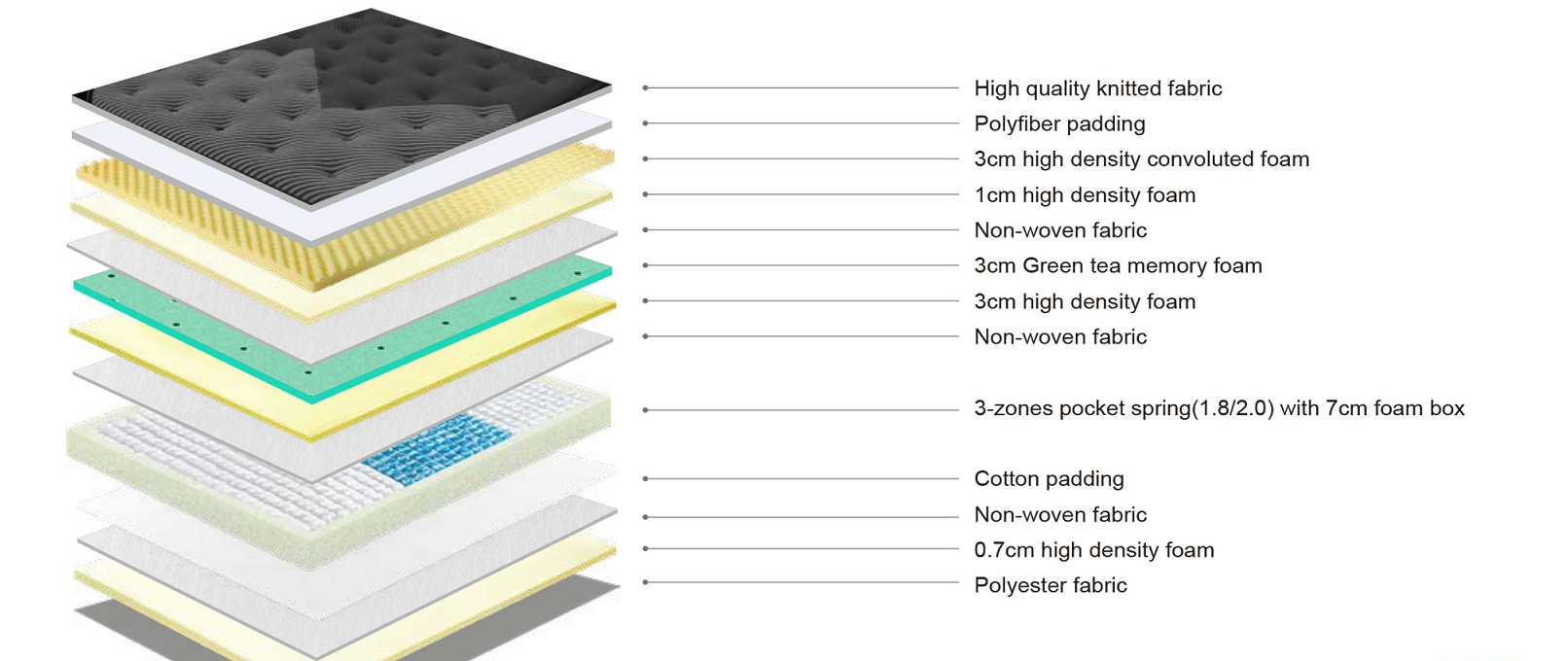
Foam, latex, and springs are often presented as competing mattress types, although a finished bed may contain more than one of them. Each material answers a different mechanical question. Foam compresses and recovers according to its formulation and shape; latex is an elastic cushioning material; springs provide a load-bearing system whose response depends on coil design and arrangement. Understanding those roles makes a product label less mysterious and helps explain why two mattresses bearing the same label can feel very different.
The useful comparison starts with the job assigned to each component. A surface layer and a structural core are not interchangeable merely because both support some weight. Thickness, position, and neighboring layers change the final response. Material names are the beginning of a specification, not the specification itself.

Foam: Contour, Recovery and Layer Design
Foam can serve as a comfort layer, a transition between soft and firm parts, or the main support structure. Its behavior depends on density, firmness, resilience, and geometry. Slow-rebound memory foam takes time to recover after compression and can contour around the body. A faster-recovering foam responds faster to position changes. Surface shapes, such as convolutions, create channels and alter the initial contact pattern.
These distinctions explain why mattress materials cannot be judged from a “foam mattress” label alone. Two foam beds can differ in layer order, thickness, and core strength. A thick upper layer may produce pronounced contouring, while a firmer transition layer limits how far the body sinks. The relevant performance appears when the stack is loaded together, not when a loose piece of foam is pressed by hand.
Materials listed by Suisin Furniture include multi-gauge high-density foam, polyfiber padding, slow-rebound memory foam, and convoluted foam. The site describes memory foam as distributing pressure and reducing transferred movement, while convoluted foam creates air channels. These functions provide a vocabulary for reading a product construction. The presence of one foam type alone does not establish the thickness or feel of a finished model.
Latex: Elastic Cushioning With Its Own Conditions
Latex used in bedding generally offers elastic compression and recovery. It can create a cushioning layer with a different response from slow-rebound memory foam. Yet the word latex does not state whether the material is natural, synthetic, or blended, nor how much of it is present. Firmness and perforation can also affect feel and airflow. When latex is considered as a bed mattress material, the buyer needs the actual layer specification rather than a category label.
The company’s compressed-mattress guidance identifies latex among materials or structures that may be designed to tolerate temporary compression. That does not mean every latex mattress, or every mattress containing latex, is suitable for vacuum packing. Compression suitability depends on the complete construction and its recovery after unpacking. The same condition applies to foam and spring combinations. A packaging decision should follow product-specific testing.
For bed mattress material comparisons, latex belongs beside foam as a possible comfort or transition component, not as proof of an entire mattress’s performance. In a hybrid, a thin latex layer may change surface response without replacing the deeper support system that carries most body weight.
Its response must be judged with the core beneath it and the cover above it. A sample can reveal the assembled feel, while a specification shows how much latex the construction actually includes.
Springs: Support Through Coil Design
For mattress materials, springs form the load-bearing core. Coil gauge, spacing, height, and arrangement affect how resistance develops under pressure. Pocketed springs are individually enclosed and can react more locally than a fully linked network. Zones can vary support across shoulders, lumbar area, and hips. The coil system is therefore an engineered structure, not a count of metal pieces.
Suisin Furniture’s materials page documents pocketed springs and thermobonded hard cotton used as rigid support and protection between springs and upper layers. Spring performance can also be adjusted through gauge, spacing, arrangement, and zoned design. Those details matter because a thinner wire, different spacing, or altered zone can change the feel even when the marketing category remains “pocket spring.”
Edges and surrounding foam influence the result. Reinforcement can keep the perimeter more stable, while comfort layers moderate how the springs are felt. A spring mattress with a substantial foam top may feel more contouring than a foam mattress built with a firm upper layer. Reading the layers in order is more revealing than choosing a spring-versus-foam side.
Read the Combination as a System
Hybrid constructions use different materials for different jobs. Foam or latex may manage initial contact, springs may carry the sustained load, and padding or protective layers may separate components. No category automatically provides comfort, durability, or safe compression. Those outcomes depend on the specified construction, manufacturing consistency, and the conditions under which it is used.
Material categories become useful only after the layers are placed in their actual order. Mattress materials can alter one another’s response: a spring core is felt through overlying foam, and latex behaves differently over a firm base. The complete layer arrangement explains the mattress far better than its shortest material label.
