
Qualifying protective coatings and polymer formulations requires reliable simulation of outdoor degradation mechanisms. Laboratory managers frequently face a fundamental crossroad: choosing between rapid screening of short-wave ultraviolet damage and comprehensive simulation of total sunlight, thermal fluctuations, and cyclic moisture.
Coating embrittlement, micro-cracking, and resin yellowing stem from specific photochemical reactions that dictate equipment requirements. Specifying an accelerated tester without isolating the primary failure mechanism leads to skewed lifetime projections, wasted qualification cycles, and costly premature field breakdowns.

Direct alignment between target service environments and laboratory light sources ensures actionable correlation. Paint chemists assessing chalking demand different spectral outputs than resin compounders monitoring polymer gloss retention or automotive exterior durability.
Photolytic Breakdown versus Solar Simulation: Selecting the Spectral Engine
Determining the appropriate irradiation source forms the core of any accelerated aging evaluation. Ultraviolet radiation can trigger photochemical degradation in susceptible polymers, while visible and infrared radiation can contribute to heating and other material changes. The relative effects depend on the material’s composition, spectral sensitivity, and exposure conditions.
Fluorescent ultraviolet testers concentrate optical energy in the aggressive short-wavelength UV region to expose rapid physical breakdown. Deploying a fluorescent weathering chamber enables technicians to evaluate resin matrix degradation, chalking, and cracking under severe photochemical stress without waiting for prolonged outdoor exposures.
Xenon-arc chambers can simulate selected aspects of solar exposure using appropriate filters and irradiance settings. The required spectral range and exposure conditions should follow the applicable test method and the material’s intended service environment.
Formulations destined for interior automotive trim, exterior architectural paints, or color-critical masterbatches require this full-spectrum balance. Evaluating polymer specimens under mismatched light curves creates artificial degradation modes that never manifest in actual service environments.
Moisture Dynamics, Thermal Shock, and Environmental Cycle Precision
Humidity and moisture drive severe secondary degradation in organic coatings and engineering plastics. Natural outdoor weathering involves nightly dew condensation, driving rain, and abrupt surface temperature shifts that crack protective barriers and leach plasticizers from polymeric substrates.
Moisture delivery strategies differ significantly between instrument architectures. Condensation cycles saturate test specimens at elevated temperatures to induce swelling stresses, whereas direct hydraulic spray arrays introduce mechanical wash-off and intense thermal shock.
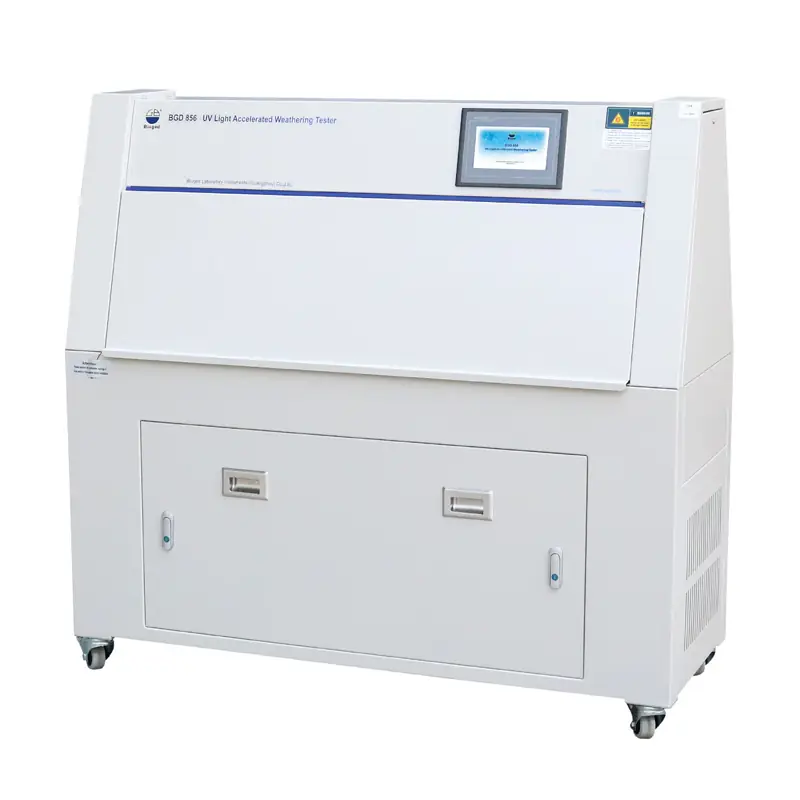
Rapid surface cooling triggers micro-fractures across brittle topcoats. Engineered by BIUGED INSTRUMENTS, the BGD 856 UV Light Accelerated Weathering Tester incorporates a 12-nozzle spray system, positioning six nozzles per side to simulate rain showers alongside 100% condensing humidity.
Equipped with an electronic ballast extending lamp life to 6,000 hours, this platform delivers irradiance from 0.3 W/m² to 1.55 W/m². Regulating black panel temperatures from room temperature plus 10°C up to 80°C ensures reproducible conditioning across consecutive qualification runs.
Specimen Geometry, Rotational Uniformity, and Testing Throughput
Sample dimensions and daily testing volumes dictate the mechanical footprint of the aging apparatus. Facilities evaluating flat sheet panels require distinct mounting arrangements compared to testing teams handling three-dimensional molded components or thick composite sections.
Flat-plane specimen arrays maximize capacity for uniform metal coupons and drawn-down coating cards. However, large batches of irregular shapes demand rotational exposure geometry to avoid shadow zones and eliminate localized irradiance variance across the exposure plane.
Rotational racks distribute radiant flux and moisture evenly over every specimen. Supporting comprehensive testing protocols, BIUGED INSTRUMENTS manufactures the BGD 860 Xenon Test Chamber, featuring a rotating-drum holder accommodating 22 specimens sized 150 by 70 mm across a 2,200 cm² exposure area.
Operating an air-cooled weathering chamber of this design delivers uniform irradiance between 0.3 and 0.75 W/m² at 340 nm. Dedicated Pt100 sensors simultaneously monitor black panel and chamber temperatures to maintain standard compliance under continuous unattended cycles.
Industrial operations requiring higher capacity can utilize the BGD 862 Plus system. Its three-tier drum structure, 6.5 kW water-cooled xenon burner, and 6,500 cm² exposure envelope deliver uniform irradiance and ultrasonic humidity distribution across heavy quality assurance workloads.
Irradiance Regulation, Optical Filtration, and Traceable Calibration
Aging lamps naturally lose optical output over continuous operating cycles. Maintaining test repeatability requires closed-loop irradiance feedback sensors that monitor emission at specific control bands, automatically adjusting ballast power to counteract burner solarization and phosphor degradation.
Optical filter selection refines spectral distribution across the exposure zone. Daylight filters simulate unfiltered direct sunlight, window glass filters replicate indoor exposure through architectural glazing, and extended UV filters produce severe short-wave exposure for accelerated failure analysis.
Traceable radiometer calibration safeguards inter-laboratory reproducibility between independent quality control audits. Periodic sensor calibration verifies that irradiance setpoints match international norms, ensuring that coating degradation rates remain directly comparable across different testing facilities and global supply chains.
Automating cycle routines minimizes operator intervention and eliminates manual logging errors. Modern control systems allow laboratory managers to store multi-segment programs, record test parameters via digital interfaces, and export verifiable historical logs for ISO/IEC 17025 laboratory quality audits.
Precision Instrumentation Partnerships for Accelerated Weathering Excellence
Balancing material degradation mechanisms against specimen geometry and regulatory testing requirements ensures reliable laboratory qualification. Matching the correct radiation engine, moisture delivery method, and closed-loop control architecture protects materials research from unrepresentative data and costly formulation errors.
Integrating a reliable weathering chamber transforms accelerated weathering from a compliance bottleneck into an agile research asset. Quality assurance teams can use accelerated weathering results to compare material durability and support qualification decisions. Correlation with field exposure data is important when using laboratory results to inform service-life estimates or durability claims.
Established as a manufacturer of precision physical testing equipment, BIUGED INSTRUMENTS engineers high-performance weathering testers, adhesion instruments, and rheology solutions for coating and polymer developers. Their systems combine durable hardware, optical controls, and compliant architectures to deliver dependable durability data.
Consult their technical engineering team today to review your testing standards, configure specimen racks, and identify the ideal accelerated weathering instrument for your laboratory.
