
Overall Equipment Effectiveness is a brutally honest metric. An OEE score of 85% is considered world-class, yet many factories operate well below that threshold, with losses distributed across availability, performance, and quality.
The gap between current performance and potential is rarely a single catastrophic failure—it is the cumulative effect of small, persistent problems that measurement systems often fail to capture in real time.

The human-machine interface sits at the intersection of these losses. Operators interact with equipment through the HMI; maintenance teams diagnose through it; production supervisors monitor through it.
When that interface is unreliable, slow, or difficult to use under industrial conditions, it can extend recovery time during faults and make existing production losses harder to control. The selection of HMI technology therefore has implications that extend beyond user experience and into production metrics.
Where OEE Leaks Occur
The Six Big Losses framework, originally developed by Seiichi Nakajima, categorizes the sources of OEE erosion into three pairs. Availability losses include equipment breakdowns and setup or changeover time.
Performance losses cover minor stoppages and reduced speed operation. Quality losses encompass startup rejects and production defects.
Each of these loss categories has a human-machine interaction component. An HMI that is difficult to operate with gloves, unresponsive to touch, or slow during screen navigation does not automatically cause a production loss—but it can delay operator responses, extend diagnosis time, and increase the likelihood of input errors.
The practical characteristics of the HMI technology therefore influence how effectively operators can manage and recover from the losses that do occur.
Availability: Keeping the Line Running
Equipment breakdowns are the most visible availability loss. When a machine stops, the clock keeps running, and OEE availability drops. During a breakdown, maintenance technicians rely on the HMI to diagnose faults and perform recovery procedures. If the interface is unresponsive or difficult to operate under the prevailing conditions, diagnosis time extends, and so does the downtime.
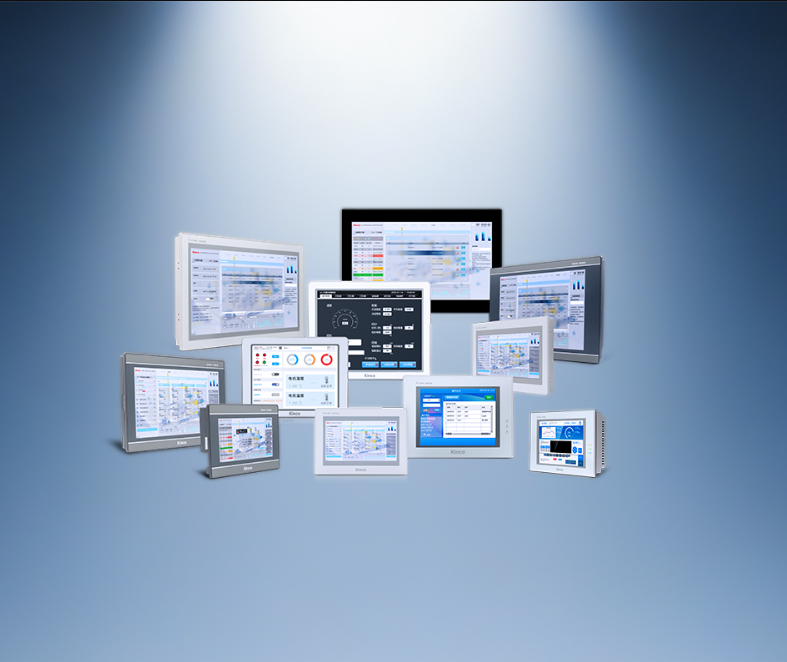
Compared with some capacitive touch technologies, Kinco‘s resistive touch screens can offer more predictable input behavior when operators use gloves or when the screen surface is exposed to light contamination. This matters because production environments are rarely clean-room conditions.
Coolant mist, lubricant splatter, and airborne particulates are routine. An HMI that maintains reliable touch registration through these conditions enables technicians to navigate diagnostic screens and execute recovery steps without unnecessary friction.
Changeover time is the other availability loss. Setup and adjustment procedures often require navigating through multiple HMI screens. A resistive touch screen supports operation with gloves or a stylus—a practical advantage during changeovers when operators may be wearing cut-resistant or chemical-resistant gloves.
The ability to interact accurately without removing protective equipment can reduce the time spent on setup tasks and help keep the changeover process moving.
Performance: Maintaining Rated Speed
Minor stoppages—typically under five minutes—often result from operator interventions: clearing a jam, adjusting a parameter, or acknowledging an alarm. Each intervention requires the operator to interact with the HMI.
A touch screen that registers inputs reliably and supports gloved operation reduces the time between recognizing an issue and resolving it. What could be a 30-second correction with a responsive interface might become a two-minute delay with one that requires multiple attempts or glove removal.
Reduced speed operation occurs when equipment runs below its designed capacity. This can happen when operators manually throttle production due to interface lag or when they cannot access the screens needed to optimize parameters.
A resistive HMI with consistent touch registration reduces the friction of parameter adjustment. Operators can make changes quickly and confidently, without the false touches that can occur on some touch technologies in industrial settings.
Processing performance also matters. A responsive HMI prevents screen navigation, alarm handling, and parameter changes from becoming additional sources of operator delay. When the interface renders screens promptly, operators spend less time waiting and more time acting.
Quality: Reducing Defects and Rework
During startup, operators rely on the HMI to verify that all parameters are correct before production begins.
A resistive touch screen offers accurate input registration, which helps reduce the risk of parameter entry errors during setup. This accuracy is particularly valuable when operators are entering numerical values or selecting from densely packed on-screen options.
During production, quality depends on operators responding to alarms and adjusting parameters in real time. If the HMI is difficult to use under the prevailing conditions—if gloves prevent reliable touches, if the screen is affected by contaminants, if the interface is sluggish—operators may delay adjustments or make incorrect entries.
The result is defective product that could have been avoided. An HMI that remains operable through dust, oil, and moisture helps ensure that operators can make adjustments when needed, rather than deferring them until conditions change.
Touch performance in electrically noisy environments also depends on the HMI’s overall shielding, grounding, and controller design. Resistive touch technology can provide a practical option where reliable physical contact is preferred, helping maintain consistent input behavior across different operating conditions.
The Operator Factor: Closing the Loop
The three OEE components—availability, performance, and quality—are not independent. An operator who struggles with the HMI during a minor stoppage may rush through subsequent parameter adjustments, introducing quality defects.
A maintenance technician who cannot diagnose a fault through a non-functional HMI extends breakdown time. The common thread is the quality of the human-machine interaction.
A resistive HMI that remains operable through dust, oil, moisture, and glove use helps ensure that operators can interact with equipment whenever they need to. This is not about convenience; it is about maintaining the feedback loop that allows operators to identify and correct issues before they become larger losses.
The HMI is the primary instrument for visualizing OEE data, downtime reasons, and production targets. When that instrument is reliable, operators can make informed decisions. When it is not, they operate with incomplete information.
For production environments where OEE improvement is a stated goal, the choice of HMI technology is a tactical decision with operational implications. The resistive touch screen, with its proven performance in demanding conditions, supports the work of recovery and control across availability, performance, and quality.
It does not eliminate the need for robust maintenance practices, operator training, or process optimization. But it ensures that when operators need to interact with the machine, the interface does not become an additional obstacle to regaining production.
