
Reliable data communication has become a fundamental requirement for industrial operations as factories, transportation systems, and smart infrastructure continue to adopt connected technologies. Different network environments often rely on a combination of copper Ethernet and fiber optic communication, creating the need for flexible solutions that can bridge these technologies. An industrial media converter plays an important role in enabling seamless communication between different transmission media while improving network stability and scalability.
For enterprises managing industrial networks, selecting suitable communication equipment requires a clear understanding of both benefits and limitations. As a professional network equipment provider, Wintop focuses on the research, development, production, and sales of optical modules, switches, media converters, and other networking products. With experience serving customers in more than 40 countries, Wintop provides network solutions designed to support various industrial and commercial applications.

Understanding the Role of an Industrial Media Converter
An industrial media converter is a networking device that converts signals between different types of transmission media, most commonly between copper-based Ethernet and fiber optic networks. Traditional copper cables are widely used because of their affordability and compatibility, but they have limitations when applied to long-distance communication or environments with strong electromagnetic interference.
Fiber optic networks provide advantages such as longer transmission distances, higher resistance to interference, and improved data security. However, many existing industrial systems still depend on copper Ethernet devices. Media converters help businesses integrate these two technologies without completely replacing their current network infrastructure.
For industrial applications, these devices are especially valuable because they support communication between automation equipment, monitoring systems, controllers, and other connected devices. This makes them an important component in building reliable industrial communication networks.
Major Advantages of Industrial Media Converters
One of the most significant advantages of an industrial media converter is its ability to extend network transmission distance. Copper Ethernet connections are generally limited by cable distance, while fiber optic connections can support much longer communication ranges. By converting Ethernet signals into optical signals, media converters allow companies to deploy networks across larger facilities, production areas, and outdoor industrial sites.
Another key advantage is improved resistance to electromagnetic interference. Industrial environments often contain heavy machinery, power equipment, and electrical systems that can affect copper-based communication. Fiber optic transmission reduces the impact of these external disturbances, helping maintain stable and consistent data exchange.
Industrial media converters also provide greater flexibility for network upgrades. Many companies cannot replace their entire communication infrastructure at once due to cost and operational requirements. By adding media converters, businesses can gradually introduce fiber connectivity while continuing to use existing Ethernet equipment.
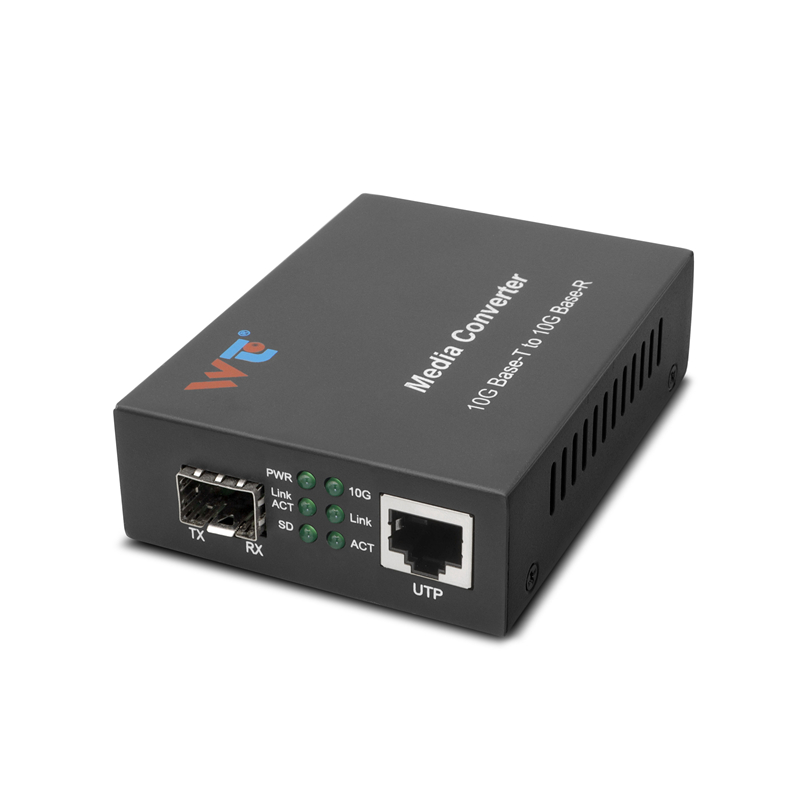
Performance adaptability is another important benefit. The Wintop WT Fiber Ethernet Media Converter WT-8100W, for example, provides one 10 Gigabit optical port and one 10 Gigabit adaptive electrical port. Its copper port supports 1000Base-T and 2.5/5/10GBase-T auto-negotiation, allowing connection with different network devices and supporting various application requirements.
The WT-8100W also supports IEEE802.3x flow control in full duplex mode and half-duplex back pressure flow control. These features help improve data transmission efficiency and reduce network congestion in different operating conditions.
Application Value of Industrial Media Converter Solutions
Industrial media converters are widely applied in industries where reliable communication is essential. In manufacturing facilities, they can connect industrial control systems, automation equipment, and monitoring platforms. In transportation and security applications, they help transmit data from cameras, sensors, and management systems over extended distances.
The flexibility of fiber configuration also makes media converters suitable for diverse project requirements. The Wintop WT-8100W supports multiple fiber transmission modes, including dual fiber multimode, dual fiber single mode, and single fiber single mode. It also provides optional working wavelengths of 850nm, 1310nm, and 1550nm, enabling businesses to select suitable solutions according to their network design.
Energy efficiency is another consideration for large-scale industrial deployments. Equipment that operates continuously must maintain stable performance while controlling power consumption. The WT-8100W features low power consumption and low heat generation, allowing it to operate reliably for extended periods.
Limitations Businesses Need to Evaluate
While industrial media converters offer significant advantages for network expansion, businesses must carefully evaluate several inherent limitations before deployment. A primary concern is the increased network complexity; these devices represent additional points of failure. Although they bridge disparate media types, they demand meticulous installation, precise configuration, and ongoing maintenance to guarantee long-term operational stability, which can strain internal IT resources.
Compatibility presents another critical hurdle. Industrial environments often feature a mix of legacy systems and modern equipment, with variations in fiber types (single-mode vs. multi-mode), transmission distances, connector interfaces, and adherence to industry standards like PROFINET or EtherNet/IP. Selecting an unsuitable converter can result in degraded signal integrity, data latency, or outright integration failures. Consequently, thorough due diligence—including rigorous technical specification reviews and pilot testing—is essential prior to full-scale deployment.
Furthermore, the initial capital expenditure is typically higher than that of standard copper Ethernet networks. The costs of fiber optic cabling, optical transceivers, and specialized installation labor can significantly elevate project budgets. However, this perspective shifts when considering the total cost of ownership. For demanding industrial applications that require electromagnetic interference immunity, electrical isolation, and reliable connectivity over extended distances, the long-term operational savings and reduced downtime often justify the upfront investment, making fiber-based solutions a strategically sound decision.
Selecting the Right Network Equipment Partner
Choosing an experienced network equipment supplier is essential for businesses that require reliable industrial communication solutions. A capable partner should provide not only quality products but also technical expertise, product development capabilities, and consistent manufacturing standards.
Wintop is recognized as a network device manufacturer specializing in optical modules, industrial switches, PoE switches, and media converters. Through continuous investment in research and development, the company supports customers with professional networking solutions designed for different application environments.
For enterprises planning industrial network upgrades, cooperation with an experienced manufacturer can simplify product selection, improve system reliability, and support future expansion.
Building Future-Ready Industrial Connectivity
Industrial media converters provide an effective bridge between copper Ethernet and fiber optic networks, helping businesses achieve longer transmission distances, stronger interference resistance, and greater network flexibility. These advantages make them valuable for modern industrial communication systems.
At the same time, businesses should evaluate factors such as compatibility, installation requirements, and investment costs before selecting equipment. With the right product specifications and a reliable technology partner, companies can develop stable network infrastructures that support automation, digital transformation, and long-term industrial growth.
