
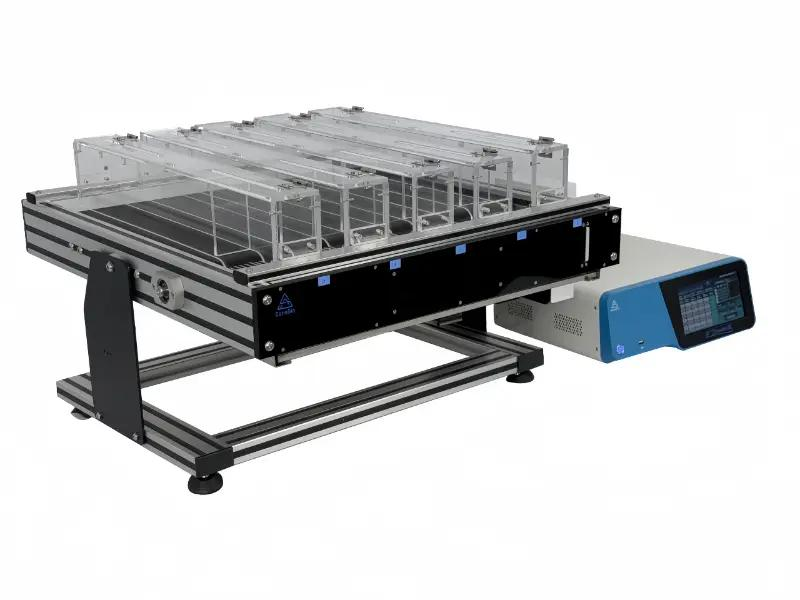
A treadmill for mice can provide controlled exercise conditions for studies of physical fitness, endurance, motor injury, motor physiology, pharmacology, metabolism, and cardiovascular research.
Yet formal data collection should not necessarily begin with the first running trial. A structured acclimation phase gives researchers an opportunity to familiarize animals with the testing environment before formal measurements are collected.
Define the Exercise Objective

Acclimation works well when it reflects the planned experiment. Endurance studies may progress toward sustained running, while rehabilitation or motor-function research may use repeated sessions at controlled workloads.
Before setting the schedule, specify the primary outcomes and the conditions that will remain consistent during formal testing.
This also helps researchers decide which treadmill settings need to be standardized. Speed, slope, session duration, lane assignment, rest intervals, and stimulation settings can all influence the exercise environment.
Prepare the Testing Environment
Before introducing movement, establish the same room conditions and handling sequence that will be used during the study. Give animals time to settle after transport into the testing area, then introduce the treadmill enclosure before starting a demanding exercise session.
Maintain a familiar routine throughout. Document room conditions, handling order, session timing, and unusual animal responses so relevant deviations remain visible during data review.
Introduce the Treadmill for Mice Gradually
The acclimation process can begin with exposure to the running lane before progressing to belt movement. A stationary period allows animals to encounter the enclosure and surrounding equipment before exercise starts. Subsequent sessions can introduce low-speed movement and progress according to the approved study protocol.
The SA101 Pro Rat/Mouse Treadmill provides individual lanes and programmable motion modes, including uniform speed, uniform acceleration, uniform deceleration, and mixed acceleration/deceleration.
Its software also supports sectional speed settings, allowing researchers to build a staged protocol rather than rely on a single speed throughout a session.
Increase Workload in Controlled Stages
Once mice are familiar with the setup, workload can be increased in planned stages. The progression depends on the study population, objective, and approved animal-care protocol. Rather than using one schedule for every project, researchers can define the progression in advance and apply it consistently across relevant groups.
For the mouse configuration, the SA101 Pro offers an adjustable speed range of 0.1–100 m/min, 0.01 m/min resolution, acceleration of 0.1–100 m/min², and a lane slope range of -25° to 25°. These settings provide several variables for adapting exercise sessions to different research designs.
Standardize Handling and Stimulation
Handling should remain as consistent as practical between acclimation and formal testing. Use the same lane arrangement, operator sequence, and relevant equipment settings when the protocol calls for them. Record animals that show unusual behavior or require a protocol adjustment rather than treating those events as routine.
The treadmill includes pulse electric, sound, and light stimulation. Pulse-electric stimulation is adjustable from 0.1–5 mA on the product specification. Any aversive stimulus should be used within the approved experimental and animal-welfare framework, with settings and intervention criteria documented for the study.
Record the Acclimation Data
Acclimation can be treated as a documented preparation stage. Record session date, duration, speed, slope, lane, stimulation settings, and observed responses. This creates a useful history for later testing and helps identify whether changes reflect the intervention or a procedural difference.
The SA101 Pro records distance, running time, number of shocks, shock time, current, exhaustion state, and speed. It offers five exhaustion modes based on distance, time, and shock, while data can be exported by USB flash drive in CSV or Excel format.
Use the Equipment’s Programmability
A repeatable workflow benefits from equipment that can translate the written protocol into consistent operating steps. The SA101 Pro uses a 7-inch capacitive IPS LCD touchscreen for standalone operation.
Its system supports eight programmable protocols with up to 20 stages per protocol, and the manufacturer states that the sectional acceleration can be set.
For multiple cohorts, keeping programmed settings, session sequence, and documentation aligned can simplify routine operation. Researchers can then focus review on experimental variables instead of reconstructing each session.
Align the Workflow With the Research Plan
A useful acclimation process connects the animal, environment, treadmill settings, and data record. It should leave researchers with a documented starting point for formal exercise testing while allowing the schedule to reflect the needs of the specific study.
Founded in 2016, BioMed Easy Technologies, a subsidiary of SANS Biotechnology, develops laboratory animal and neuroscience research equipment. Its official website lists CE and ISO9001 certifications and support for more than 3,000 laboratories globally.
The portfolio spans major behavioral categories for motor coordination, pain, learning and memory, anxiety, fear, reward, metabolism, and related research.
Mouse exercise research can use the SA101 Pro’s five lanes, individual lane control, programmable speed modes, adjustable slope, exhaustion settings, and data export options.
BioMed Easy also provides technical support, training, and after-sales service. Review the official Rat/Mouse Treadmill specifications and contact the team to discuss equipment configuration and workflow requirements for your study.
